Tuesday, January 31, 2006

Higher Education - Out-of-Step with Society

David Wiley, in his blog, iterating towards openness, has some text from his testimony to to the US Secretary of Education’s Commission on the Future of Higher Education. He says -

In summary, higher education has fallen out of step with business, science, and everyday life. In order to realign itself with changes in society and in its student base higher education must find the will to innovate in the areas of openness, connectedness, personalization, and participation. I believe that openness is the key to enabling other innovations and catalyzing improvements in the quality, accountability, affordability, and accessibility of higher education. It is my recommendation that the Commission do everything within its power to promote a commitment to openness within higher education. In thinking about this work the Commission might fruitfully consider the many ways in which colleges and universities have collaborated with state and federal organizations to promote a culture of diversity in higher education.


Higher education in Canada needs the same openness to these kinds of innovations. We need to include the teaching and learning possibilites available through the web in our classes both as curriculum and as support for the curriculum.

tags


Monday, January 30, 2006

More on Blogs


One of the interesting aspects of the web is that you don't always have to re-invent the wheel. Here is another page, called The New Learning Technologies Buffet, explaining what blogs are, with many examples of all types of blogs, including educational blogs.

Enjoy your meal ;-> http://learntech.pbwiki.com/TryBlogs

tags

Tuesday, January 24, 2006

A Blog to Follow


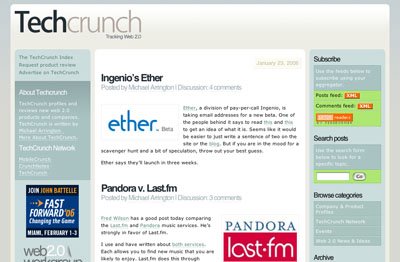
One of the most rewarding blogs in my Bloglines is TechCrunch. From TechCrunch, I have learned about all kinds of new applications, many of which are free. I recently read about a learning management system there - nuvvo - which is web-based. It's aimed at elearning, but I could see it being useful in a blended learning classroom environment as well.

Saturday, December 31, 2005

Using Blogs as part of Teaching

Yes the web is overwhelming, and information (knowledge?) management is a huge issue. There are solutions, but it takes a while to find them and then get into the habit of using them. That's the nature of the beast (feast)!

In my opinion, you do have to find a chunk of time almost every day but after the initial surveys of the terrain, you can decide on your focus and stay up-to-date in that area (depending on its breadth and complexity) with an aggregator (like Bloglines - which is free and easy to set up). I found this description of how a teacher could use Bloglines with a class really helpful - http://www.weblogg-ed.com/2004/03/03. After reading it I set up my own Bloglines account and now use it to track the educational blogs I'm interested in, scan their headings, and, if I'm interested in the topic, link to it and get the gist.

Blogs are being used more and more as part of teaching and learning. For a basic understanding of how to use blogs, check out Jakob Nielsen's info - http://www.useit.com/alertbox/weblogs.html - He's the senior acknowledged expert on web design.

http://www.weblogg-ed.com/why_weblogs provides an overview on using blogs in the classroom with lots of links to explore (Or not ;-> depending on your time and interest.)

Finally, here's a link to a short video describing the uses of blogging in high school - http://www.weblogg-ed.com/weblogs_in_ed_video

A friend says -
My feeling is that we have to treat "computer reading" like people used to treat reading the newspaper in the past. It was an activity that occupied a certain part of everyday.


and I agree.

tags


Monday, December 12, 2005

Shifting Semiosis

Two or three years ago I began talking about a "shifting semiosis" and I felt like Cassandra - although I wasn't prophesying a disastrous war, but rather a massive, fascinating and largely positive change. It was clear to me that we were at the start of a change in the way we humans signify meaning that would dwarf the printing press, audio & visual recording, and mass media combined. And now, in my daily newspaper, I find that my intuitive recognition is being substantiated.

I read an article, linked to this post's title, in the Toronto Star, www.thestar.com - called Old Idea, New Media. The subheading asks this provocative question -
Are you reading this text on paper, or as pixels? Does it matter? Some think not.

As newspapers realize that they sell content, not ink, their future is taking hold.

I put down my paper and went immediately to my computer and read the same story in pixels, because I wanted to share this increasingly undeniable change. I wanted to blog about it.

The article is about how newspapers are still remarkably profitable (many at 20% a year!)about how newspapers are a natural fit as a web portal, about how the papers' managers are finally beginning to realize that, and about how transportable digital downloads are coming. I picture these as much like ipods in function but looking more like paper or a book.

So, yes, our semiosis is shifting! Not that I expect any more attention to my message than Cassandra got to hers. (In some ways I wish I was more like Paul Revere;->)

The papragraph that electrified me, which follows, clearly indicates that the web is a platform, not a medium.
A newspaper of the future might employ web editors for each section of the paper whose task would be to rapidly accumulate multimedia content relevant to each story. Articles posted on reformulated newspaper sites will be accompanied by related photos, audio and video clips, speech transcripts, discussion forums and archival images from the CBC, CPAC, C-SPAN, the National Film Board and other partners.

Such wonders we are seeing as human communication continues its development
  • from speech and drawings
  • to (chirographic) writing
  • to printed text and engravings
  • to photography, audio recording, film, & television

and now to versions of all of these available asynchronously on the World Wide Web!

Wednesday, December 07, 2005

Students' Computer Patterns

Here is a current, brief, informative interview with Robert Kvavik on how students are using computers, and their attitudes towards how computers are being used in education. Mitchell Weisburgh quotes Kvavik as saying -
It’s not that tech doesn’t affect learning, it’s that we are only at the beginning of seeing how tech can be used in support of that goal.

I think he makes a truly important observation here -
One of the interesting things with Google is when you ask a question, you always get an answer. But you don’t know if it’s a good answer. So how do you show students how to sort that and digest it so they can tell the difference?

One of the things is that these students have more and quicker access to information than our generation did, but there would be a great benefit to learning how to winnow it out and apply it in a sophisticated way to a problem.

All teachers in all classes should be modelling and teaching how to evaluate the information found on the web, in my opinion, as a part of learning the content of courses.
On course management systems, Kvavik has this to say about student attitudes:
To the extent the faculty uses the CMS so that students can take sample tests, access readings, contact the professor, and submit assignments; the CMS has made it easier for the students. The biggest complaint is that the use is not consistent, it’s only used in about 20% of the classes in a lot of the institutions. Why in one university, would the Poli Sci dept decide not to use the CMS at all while the history dept is 90% using it? Students do not like the inconsistency.

Altogether an interesting read - I recommend it.

Tuesday, December 06, 2005

Academic Research - The Process is Changing

Academic research is changing, just as academic writing has changed with the arrival of the computer. Academic writing is radically different since I was an undergrad many years ago. When I wrote my Ph.D. thesis a year and a half ago, I made rich use of the capabilities of word-processing as an integral part of my writing process. I used Styles for my headings and for generating a table of content. I used the caption feature to describe the images I inserted, and to generate a table of figures. Of course I used the spell checker and the word count and all the flexibility of copy-and-paste. Plus I made sure the font was attractive and readable, and for my particular thesis, I used the font to help deliver the meaning. Writing with a word processor is more fun, more visual, and easier than the ugly old manual typewriters of my youth.

I also used EndNote to make my citing much easier and to generate my "Works Cited", and I paid highly for the privilege; it was expensive. During the process of writing my thesis, I was forced to switch from an IBM laptop to a Mac iBook; (don't ask.) I had to pay again for EndNote to get a Mac version. But anything was better than the picky work of sorting out the anal details of citing the the "Works Cited".

(These days I point my students to easybib http://www.easybib.com where they can generate MLA bibliographies for free and APA for, I think, about $6.00 U.S. a year. Not quite as good as EndNote but much cheaper.)

And now researching and citing is going to get much easier, in the same way creating a document got much easier with the advent of the computer and wordprocessing.

I wrote a couple of months ago about changes coming for the University of Toronto library and for all the Ontario universities - http://elgg.net/vinall/weblog/2769.html - and today Stephen Downes http://www.downes.ca/ posted a link to this site - http://echo.gmu.edu/toolcenter-wiki/index.php?title=Firefox_Scholar_(aka_SmartFox) - on the upcoming SmartFox.

SmartFox will enable users, with a single click, to grab a citation to a book, journal article, archival document, or museum object and store it in their browser. Researchers will then be able to take notes on the reference, link that reference to others, and organize both the metadata and annotations in ways that will greatly enhance the usefulness of, and the great investment of time and money in, the electronic collections of museums and libraries. All of the information SmartFox gathers and the researcher creates will be stored on the client's computer, not the institution's server (unlike commercial products like Amazon's toolbar), and will be fully searchable. The Web browser, the premier platform for research now and in the future, will achieve the kind of functionality that the users of libraries and museums would expect in an age of exponentially increasing digitization of their holdings.

SmartFox is being developed by the Center for History and New Media (CHNM) at George Mason University with funding from the Institute of Museum and Library Services (IMLS).


Being a scholar is becoming more and more about knowledge and ideas and less and less about arcane processes and details. And that's great, in my opinion

Friday, December 02, 2005

Resistance to Teaching Online

Christopher D. Sessums' blog post Resistance is Useful: Thoughts Concerning How to Respectfully Move Teaching and Learning Online a commentary on education in the online age is an interesting and thoughtful piece. He concludes:
Whether you are teaching online or face-to-face, educators are presented with a number of challenges in getting students to adopt skills and demonstrate intellectual and practical dexterity of many complex concepts. We might even say, teaching and learning is all about being open to and coping with perpetual change, taking calculated risks. Many academics view online teaching and learning with suspicion, and rightly so. Today’s learning technologies will revolutionize and affect colleges and universities as we know them. Faculty and administrators should be aware of the changes technology affords and question the implications deeply and critically. This act of looking critically should not stop at the technological level; it needs to consider the entire range of operations that comprise the acts of administration, teaching and learning; from the effectiveness of tenure and promotion policies to the effectiveness of multiple-choice high-stakes student examinations.


I have been teaching in face-to-face classrooms using laptops (for the "mobile" programs) with the web and WebCT, for over six years, and I largely agree with his analysis. However, I am going to comment on two aspects that are probably beyond the scope of his article.

First, the students today write, read, and learn differently than they did even five years ago. (I have an article that expands part of this point at ) Increasingly we teachers will have to learn how to help students learn how to learn in their new semiotic landscape. And we are digital immigrants ourselves!

In addition, the students, even the technologically proficient among them - and that's fewer than many people assume, need to learn critical thinking skills about the sea of content they swim in on the web. This worries me tremendously because so few educators are taking leadership in this vital area, in my opinion. Which brings me to my second aspect ...

The web is a multi-media platform, rich in visuals and sound as well as text. Almost all educators got their credentials in a text-focussed environment. Many of them (us?), I believe, fear the web (quite rationally) because it requires abilities and even perceptual training that they simply don't have. The story of what happened at Sheridan when we put thousands of students - and their teachers - into a mobile environmentover a very few years which I lived through, illustrates the kind of learning community that can develop and support educators in this transition, and how some adapt and some resist, no matter what the circumstances.

I agree with Sessums that the "the entire range of operations that comprise the acts of administration, teaching and learning" need both a critical examination and change as rapidly as possible.

Wednesday, November 23, 2005

My Failed Podcasting Experiment

If you click on the title, you will hear my brief podcast on how Walter Ong's concept of "secondary orality" - the orality that comes after text literacy, or with text literacy. I am in the classic learning-by-doing mode. First I used Blogger's Audio-Blogging tool and phoned in a blog. (See the post below.)

For this podcast, I used Audacity to create a recording, and iTunes (on my iBook)to reduce the size of the resulting mp3. Next I uploaded my mp3 file to ELGG, the very interesting learning landscape and eportfolio site, and used the resulting url to link to this blog, in the title.

In order to be able to do this, my learning path has been through reading educational technology blogs (take a look at my Blogroll, below on the right) and learning about podcasts. I sampled some, and then began searching the web to find out how to create one myself. The result, here, came from this searching and reading and trying and cursing, and searching some more and the bright idea (if I do say so myself)of using my ELGG account to host my mp3. I never did figure out how to do enclosures, and I wasn't sure which software might work for me.

So I have more to learn;->

... And I've been editing and re-editing my link to my mp3 file because my initial link corrupted.


... Still Trying

Wednesday, November 16, 2005

Trying Out Audio-Blogging!

Using http://audioblogger.com/ I phoned in this, what should I call it, audioblog, podcast, whatever, with a very few thoughts on Ong's "secondary orality" - of which this is an example!

this is an audio post - click to play

Monday, November 14, 2005

Searching Through Metadata

What I find really, really exciting about the web is the way it allows me to access material. When I'm writing, I sometimes find myself at a loss for a quote that I want to add. If it is in my collection of books, sometimes I can find it, especially if I remember who the author is. But sometimes I just remember a phrase, and not the source. Quotation marks around that phrase and Google allow me to find it easily.

David Weinberger, author of Small Pieces Loosely Joined, about the web culture, (and a fellow at the Harvard Berkman Center for Internet and Society) has speculated on the direction of these possibilities. First he points out how we have historically attempted to categorize books:
We've been managing book metadata basically the same way since Callimachus cataloged the 400,000 scrolls in the Alexandrian Library at the turn of the third century BC. Callimachus listed the library's contents on scrolls, Medieval librarians used ledgers, and we use card catalogs, now mostly electronic. But until information started moving online, the basic strategy has been the same: Arrange the books one way on the shelves, physically separate the metadata from them, and arrange the metadata in convenient ways.


In the Boston Globe article this quote is drawn from, he looks at the impact of the web on how we organize our information about books and other information - our metadata:

The real challenge to traditional publishing today comes not from the digitizing of books, then, but from the very nature of the Web itself. Using metadata to assemble ideas and content from multiple sources, online readers become not passive recipients of bound ideas but active librarians, reviewers, anthologists, editors, commentators, even (re)publishers. Perhaps that's what truly scares publishers and authors about Google Print.


Yet what makes me worried is how few people are actually capable of searching in a more sophisticated way. Even the basic technique of adding quotation marks around a name or phrase when you search is not well known.

tags

Friday, November 04, 2005

How We're Using the Internet: Survey Results

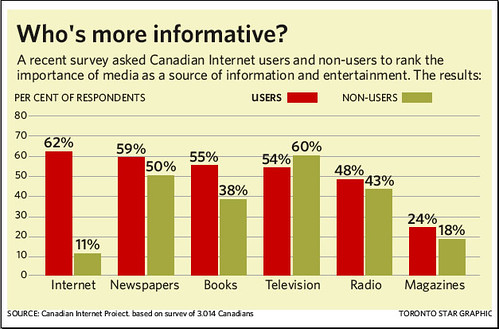
Some info gleaned from the Toronto Star - in an article by Tyler Hamiton

"While Internet use has a measurable displacement effect — with some time that might have been spent watching television, listening to the radio or reading magazines and newspapers instead devoted to the Internet — our data support the general conclusion that, for most users, the Internet serves more as a supplement to traditional media than a replacement," the study concluded.

"Internet users, it would seem, are simply more media-oriented than are non-users."

The results are based on a survey of 3,014 Canadians at least 18 years old who answered questions in a telephone interview in May and June of last year. The margin of error is 1.8 per cent, 19 times out of 20.

The study is the first to come out of the Canadian Internet Project, an ongoing research initiative led by a consortium of universities and supported with provincial, federal and private-sector funding.


Here is a chart, also from the Toronto Star, under the link "Survey Results", comparing users with non-users.

StarNov2WebSurvey

Get the Executive Summary pdf from the Canadian Internet Project website.

tags


Wednesday, November 02, 2005

What Do You Want to Do?

People share on the web. It's an attractive aspect of the culture. Phil Bradley has a useful web site. His
"I want to..." Page is especially helpful:
"I want to..." is a page of utilities, such as social utilities, social bookmarking and various other software packages that let you do things. (Added 27/10/05)


Definitely worth Furling and/or bookmarking.

Saturday, October 29, 2005

For Math Phobics & Math Teachers

From http://blogs.zdnet.com/emergingtech/?p=38&tag=nl.e539
Courtesy of WWWTools for Education

'Aesthetic computing' turns algebra into art by ZDNet's Roland Piquepaille -- The concept of aesthetic computing can be used to teach algebra by encouraging students to express equations as pictures or stories. This approach aims to make abstract ideas or algebraic formulas look 'real' through drawings, sculptures or computer graphics.

Friday, October 28, 2005

Scanning & Gisting - Reading on the Web

We scan through information and catch the gist. Then, if necessary and/or interested, we can slow down and read a particular piece, or in a particular area, more deeply. Deep and/or close reading and scanning & gisting are separate, though connected skills that can be learned and practiced. The Web and the Information Age requires a broader set of reading skills, in my opinion.

George Siemen's post, "The Joys of Shallow Thinking" in his Connectivism Blog describes it well:

What happens when we change how we interact with information? We "ramp up" our processing habits. Instead of reading, we skim. Instead of exploring and responding to each item, we try and link it to existing understanding. We move (in regards to most information we encounter) from specific to general thinking…from deep to shallow thinking. Shallow thinking, in this sense, isn’t as negative as its connotations. Shallow thinking (perhaps I need a better phrase) involves exploring many different sources of information without focusing too heavily on one source. Aggregating at this level helps us to stay informed across broad disciplines. So much of education intends to provide “deep learning”. Often, however, “shallow learning is desired” (i.e. we want to know of a concept, but we don’t have time or interest to explore it deeply). All we need at this stage is simply the understanding (awareness?) that it exists. Often, learning is simply about opening a door…


And Bloglines, or other aggregators, facilitate the process.

tags

Thursday, October 27, 2005

"Participation Engenders Competence"

For an inspiring description of the impact of students writing on blogs, see Konrad Glogowski's post in his Blog of Proximal Development.

He says -

When I think of blogs, I think primarily of what this technology enables my students to accomplish. When I look forward to reading their entries and comments I am really looking forward to thoughts made visible.

And so, when they write, I don’t want the journey to end with me as it inevitably does when the teacher is the audience. I want to be part of the collective journey. I want to lurk and see how my students develop their ideas. I want to see how conversations grow. I want to hear their voices booming through their entries. You can’t have that when you’re busy correcting spelling and fixing sentence structure.

My approach to marking has become more holistic. I’ve discovered that students who participate in communities of learners begin to care about their writerly voice. Gradually, what emerges is greater awareness of how to make that voice heard and how to effectively communicate one’s ideas. The most valuable part of this community is that this awareness emerges as a result of online interactions, of hundreds of entries, comments, and connections made online as part of a collective journey. It comes from within because the students need it to emerge. It is a practical skill that they need to keep contributing as members of the community. It is not imposed by my rubrics.


Check out the whole post.

tags


Wednesday, October 26, 2005

Implications of the Web for Post Secondary Institutions

From the Toronto Star, October 25, 2005
http://www.thestar.com/NASApp/cs/ContentServer?pagename=thestar/Layout/Article_Type1
&call_pageid=971358637177&c=Article&cid=1130147342095&DPL=IvsNDS%2f7ChAX&tacodalogin=yes

You know a diploma is worth less and less. Soon it's going to be worth nothing at all.

If you've just completed an undergraduate degree you might not want to hear what Mississauga-based futurist Jim Carroll has to say.

"For young people I think one of the things they will need to understand is the skill of `just-in-time' knowledge," says Carroll, who advises companies across North America.

He explains that "just-in-time" knowledge is the skill of learning information during quickly advancing periods of change. The information learned is entirely — and possibly only — relevant at a specific time. Learning it will require people to immediately dump previous information that is no longer relevant at the same time.

"The concept of going to school for knowledge is kind of quaint," says Carroll, who foresees a future when longer degree programs will become almost obsolete. "What is the relevance of a three or four or five-year degree program when half of what kids learn in their first year will be obsolete by the time they graduate?"

Carroll says the majority of knowledge needed in the workplace of the future will be gained from collaborative social networks, online sources and independent learning.

As far as formal education goes, he doesn't think many degree programs will be longer than about nine months.

"A survey I saw a couple weeks ago said young people now think self-employment is more secure than a corporate job.

"As young people continue to completely reject the concept of the traditional workplace they will also move to educational models that suit their relationship with a changing work world."

In many ways the educational system has avoided the Web and left young people to make their own way through it. Most of them have discovered peer-to-peer file sharing for music, and some of them have discovered porn. Few know much about how to evaluate the trustworthiness of sites, or understand either the law or how easy it is to see what they're doing on the Web.

We need to teach ourselves and all our students
  • how to apply critical thinking to what we find on the Web
  • how to research effectively on the Web
  • how to use library databases
  • how to use the Web as a learning tool/medium

My observations lead me to believe that we educators are abandonning many young people to discover the Web on their own, without our guidance, in the communication space they increasingly inhabit. Jim Carroll's prediction will come true for sure, if we don't join these digital natives, and share what they need to learn, while learning what they can share with us.

tags


Monday, October 17, 2005

Are Blogs a Genre, or, Are there Genres of Blogs?

What do readers of blogs expect? Do they expect a certain kind of prose? Do they expect images? Is (Are) there (a) distinct genre(s) visible in blogs?

An interesting site - Introduction to Genre Theory - although it's chiefly about the audience construction of T.V. genres has this to say:

Constructing the audience

Genres can be seen as involved in the construction of their readers. John Fiske sees genre as 'a means of constructing both the audience and the reading subject' (Fiske 1987, 114). Christine Gledhill argues that different genres 'produce different positionings of the subject... Genre specification can therefore be traced in the different functions of subjectivity each produces, and in their different modes of addressing the spectator' (Gledhill 1985, 64). And Steve Neale argues in relation to cinema that genre contributes to the regulation of desire, memory and expectation (Neale 1980, 55).


When I post to my blog here, or my personal blog in ELGG, I try to ensure that my tone is casual and I don't use too much theoretical terminology. (Today is an exception, or a new trend. I haven't decided yet;->) I do, however try to keep my spelling and grammar correct and carefully gauge how much personal information I include. I might get a bit more theoretical in the ELGG Pedagogical Impact blog and a little more impersonal. All these writing behaviors have emerged for me from reading other educationally-oriented blogs.

However, when I lurk in MySpace I see a very different blogging style and tone. It's much more casual about correctness, and much more revealing of personal information and narratives. Interestingly, it's also professional in its own way, as bloggers post information about performances and other things they wish to find an audience for. I see it as a different genre of blogging, a more social and youth oriented one.

So my current take on blogging is that it's a collection of related but distinct genres, evolving and taking firmer shape as more people read and write blogs and enact their expectations.

Friday, October 14, 2005

A Screencast on Educational Blogging

Wow! This screen cast really covers what you need to know to engage in educational blogging. Courtesy of Stephen Downes. Uses a big bandwidth and Quicktime - a free download, with Quicktime for Windows on the bottom left.


Check out Brian Lamb's Beyond Blogging screencast if you're thinking about using blogs educationally. He shows you what is possible and what is needed.

tags

Wednesday, October 12, 2005

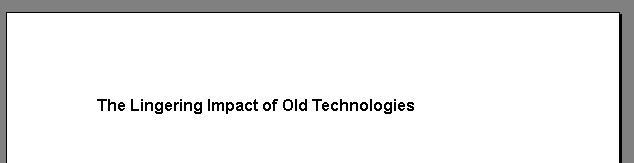
The Lingering Impact of Old Technologies


OR


Which looks better, the underlined heading or the bolded and increased-size heading?

I insist my students use MS Word's Styles to set their headings. I further insist that they not underline their headings. When one student spoke up and complained that she had been taught to underline headings all the way through high school and she thought it looked better that way, I found myself explaining my reasons.
  • Graphic designers generally agree that underlining doesn't look good or increase readability.
  • Most people now associate underlining with linking on the web, not with headings.

And most importantly
  • Underlining titles is a remnant of an antique technology - typewriters - where the only way you could signify that something was a heading was to move the paper backwards and add underlining to the words of the heading. You couldn't bold or increase the size; you could only underline.


So my student had had her eye trained to accept underlining as signifying a heading, and what she is actually signalling is that she isn't effectively using the flexibility of the new technology of word-processing to communicate visually. And people read this kind of information at a close to subconscious level, so she, and others, are actually signalling the lingering impact of typewriters and their resistance to learning the new technology of word-processing.

tags