Tuesday, January 01, 2008

Using Styles for Academic Papers, & Zotero for Research

Writing essays, papers, dissertations and other academic pieces is (or should be) radically changed by two tools:

  1. the Styles tool in word-processing;
  2. Zotero, the Firefox researching tool.

Teachers who have your students research and write, take note: your students need to learn how to use these tools, consequently so do you;-> There's an article on the Next Generation of Bibliographic Manager in the latest issue of Innovate, a journal of online education. You can register for free and get an email notifying you whenever a new issue and the related podcasts are available. I recommend it, especially if you plan on getting further education yourself. (Most of the links to tutorials below come from the article on the bibliographic manager, Zotero.)

The Styles Tool

The name of this tool confused me for a long time and I initially avoided it. Luckily, one of my students took the time to explain it to me, and I immediately set out to lean how to use it because I could see how time-saving it would be. Here is a brief explanation of what Styles is and why it's so useful: http://spot.colorado.edu/~baileysm/tutorials/Word_Styles_Demo.htm Although this demo is based on MSWord, a version of Styles can be found on the free office software, NeoOffice, and on the Mac iWorks word-processor, Pages.

Just the automatically generated and clickable updating of a Table of Contents is worth the time it takes to learn how to use Styles. Not to mention the fact that it is simply part of a professional writer's skillset.

Managing Research and Creating a Bibliography

You can get a sense of why Zotero is so important and useful by checking out this Zotero Quick Start Guide, especially the two brief videos.

While I recommend getting students using Zotero ASAP, some easier bibliographic tools, without the research component, are the following:

  1. http://www.easybib.com/
  2. http://www.bibme.org/
So get ready for writing your own academic pieces and helping your students write theirs by learning about these tools and practising using them.

Cross published at http://www.commun-it.org/community/vinall/weblog/663.html

Thursday, December 27, 2007

Tagging - For Organizing Information

One of the most important aspects of the web today is a way of organizing information called tagging (or, on Blogger, labelling). You could say that tagging is the child of alphabetical indexing - a post-Gutenberg information management invention - and hyperlinking - a web networking development. You can see what this looks like in the tag cloud pictured below.
http://en.wikipedia.org/wiki/Tag_%28metadata%29 (If you want to learn about Web 2.0, you can click on the link to Wikipedia and then click on the various hyperlinked terms in the image to read the Wikipedia definitions. The size indicates how often each is used.)

A Very Small History Lesson
Humans spoke before we wrote and for centuries we dealt with information by remembering, sometimes using memory aids like rhyme, rhythm, and formulaic storytelling. Then writing developed, and people could note down information, and compose stories. Sacred writings passed wisdom along the generational chain, with "books" being tied together into one unit, no matter what their subject matter. A small elite of those who could read and write formed, and were usually part of a priesthood devoted to preserving, accumulating, and passing along the wisdom. All the "books" were hand-copied and some priests had books virtually memorized, but that didn't create the absolute uniformity that came with the printed word.
from - http://etc.usf.edu/clipart/4200/4255/printing-press_1.htm

When the printing press was invented, exact copies could be made, and human interventions, mistakes and alterations didn't cause variations among copies. Reading, in the European world was still associated with the sacred, although universal literacy was seen as a way to allow everyone to have immediate connection with the Holy Scriptures rather than having to go through a hierarchy of priests. With the growth of universal literacy, many other developments followed, including the ability to "read" (and interpret) the same texts differently, which created dissent. People began to reproduce books other than scriptures, and thus to share and spread philosophical and scientific thought, which sped up "progress" and led to even more differing opinions.

For scholars and readers, other developments were built on the uniformity of the books being published using a printing press. In order to avoid reading a whole book while looking for one piece of information, the organizational development that most links (pun intended) to tagging was developed.


While information and ideas were being discovered, collected, and published, readers began to want to read just parts of (non-narrative) books. Now that many people could read books where the pages always stayed the same, it became easier to manage information. Scholars started creating categories, or taxonomies, so they could find specific information quickly and completely. They began using indexes at the ends of books, and alphabetizing these indexes; it was worth the time it took for someone to index the information in a book to make it more accessible to the many readers of the book.

It quickly became essential for any learner to learn how to use indexes in books and in libraries, and systems of organizing information developed as rigid categories were set up, and people learned how to use them.

With the arrival of the World Wide Web came the possibilities of hyperlinking. Taxonomies & alphabetical indexing (top down hierarchically controlled) plus hyperlinking (giving choice in reading/viewing paths)combined and in Web 2.0 tagging was born.

I use tagging for my blog posts, to make it easier for readers to search for the topics that interest them. However, the real power of tagging, for me, comes with my online bookmarks. I use del.icio.us - to collect website addresses, URLs, for future reference. I use words or phrases that have meaning for me as keywords. Sometimes when I'm adding a site to my del.icio.us account, a tag may be a general topic, like, say, "social_bookmarking" or it might be highly idiosyncratic, like the course code of a course I teach, or I might add both plus the name of a friend whom I'll send the link to next week, or all of them. For example,


While I check through the blogs I follow, using my feed reader, I don't read them in full, but I do add the relevant ones to my del.icio.us account, and now have an extensive collection of tags -

far more than I can show you in a screen shot. They are an invaluable resource, and they are named for my interests and needs, not according to a rigid and prescribed set of terms.

Tagging is a new and highly useful way to organize information, a method that didn't exist, before the web.

Wednesday, December 26, 2007

Understanding PLEs and Learning

Through Stephen Downes' OLDaily I encountered What the Heck is a PLE and Why Would I Want One?. It is aimed at teachers, but students and parents would find its brief, clear explanation of the differences between Course Management Systems (CMS) and Personal Learning Exvironments (VLE) helpful.


Have your sound up when you check it out.

Thursday, December 20, 2007

How Lucky Do You Feel About the Environment?


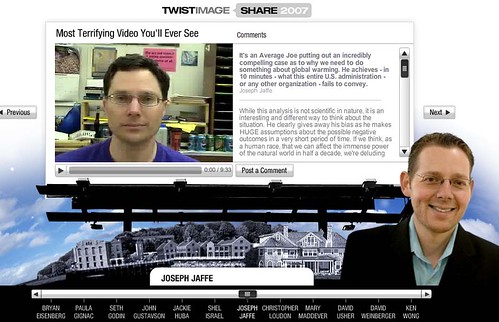
Through Twitter, (and sorry but I can't remember whose blog), I discovered an interesting and diverse collection of 2007 videos - one is essential to watch. Our lives depend on it, - - - and it can be used in schools to teach critical thinking. Here is the link: http://www.twistimage.com/share2007/#/Joseph-Jaffe/


I urge you to watch it and share it!

Monday, December 17, 2007

Canadian Copyright - Educate Yourself!

From Michael Geist's Blog - http://www.michaelgeist.ca/content/view/2431/125/ - how to take action - and power!

The Good and the Bad News About Teaching Writing

Now that I am no longer buried in teaching and marking, I can begin to read (and learn) from my favorite blogs again. Here, through a link from my favorite information disseminater, Stephen Downes, is a clear honest evaluation about the state of writing, and teaching writing, and why this is important in the overall scheme of things, by Michael Umphrey. Please read it!
How to Improve the Teaching of Writing/

Thursday, November 22, 2007

A Novel at 14


For about a year and a half I've been working with a very bright young woman, now 14 years old. I am pleased and proud to announce that she has recently published her first novel, Amelie of the Mitesen. It is a coming-of-age story set in a fantasy world somewhat similar to that of the Metis.

I did none of the writing; I simply told her what I thought was well written, and where she needed to add more of a set-up to parts of the story. It is all her ideas and all her words.

Feel free to order a copy from Lulu.com - http://www.lulu.com/content/1151511

Saturday, November 17, 2007

In My Study

Shadows
What the sun says in passing ...

Past Prime
The remains of beauty.

Sunday, November 04, 2007

Hacking Mail Accounts

I heard a disturbing story today from a friend. She has a Yahoo mail account, or rather, she had one. Someone hacked into it and sent emails to everyone in her contacts list. I can't remember if she said all her files were destroyed as well; we were both rushing in different directions.

All her contacts got an email starting "Hello Dear" which her kids immediately recognized as a fraud because she never uses that kind of phrase. The email continued, telling her contacts that she was stranded in Africa, and where they could send the money she needed to get back home.

I don't want to increase anyone's paranoia, but that level of fraud is pretty scary. My friend is a smart lady, and she took action immediately, but it has caused her a lot of trouble and anxiety. I don't know what would allow that kind of security breech. Does anybody know how to avoid that kind of hacking?

Wednesday, October 31, 2007

Urban Architecture - Reflecting Contrast


Lately I keep 'seeing' the contrasts and correspondences of current urban architecture and how it frames itself. Digital cameras entice me to practice seeing what I see.

Friday, October 26, 2007

Zonbu - A Green and Cheap Computer

I was sitting in my exercise Second Cup, a 20 minute walk each way, and leafing through one of the magazines - Forbes, I think, when I came across and article on a new make of computer. I could hardly get my head around the price for Zonbu, a computer.

Just $99.00 - (and currently, it doesn't matter whether that's Canadian or American!) It's a gift price. Even though you have to supply a keyboard and pay $12.95 (or more) a month, it's still remarkably cheap.

I like the set-up, too. I'm a fan of online applications, especially free ones. I already use Firefox and Open Office, and store some of my files online in my G.Space - http://www.getgspace.com/ and in my Box account. I think the plan to use the web is very forward thinking.

This is not an advertisement and I'm not going to give up my Mac for a Zonbu just yet, but this is the future. High storage and high cost applications will be for professionals, and perhaps the first home computer. Second or third computers, and computers for students, will be Zonbu computers, or something like them.

Monday, October 22, 2007

Mac + Kitten - Way Too Cute!

Sometimes even cuteness has a purpose

My apologies if you're offended by cuteness or kittens, or Macs;->

Found through Christopher Sessums

Saturday, October 20, 2007

A Wiki Showcasing Web 2.0 Learning Tools


releasethehounds - http://releasethehounds.wikispaces.com/ is a wiki aimed at teachers and showing what can be done, by teachers and by students.

Among the tools it showcases are VoiceThreads, - www.voicethread.com - YouTube, - http://www.youtube.com/watch?v=ZZfqOTWQCuA - and SlideShare, - http://www.slideshare.net/charbeck1/scribepost-119097 - all free and fairly straightforward to learn how to use. All both audio and visual.
Courtesy of the prolific and generous Stephen Downes's OLDaily

Thursday, October 18, 2007

The Information Revolution

I believe that we are in the middle of an amazing shift in our knowledge semiosis. After about 6000 years of writing and 400 years of print, we are in the digital age with world wide access to an abundance of information, available on a world wide platform, delivered in a mixture of media. Michael Wesch has put another of his brilliant short videos up on YouTube, this one demonstrating the impact of the information revolution we are currently careering through.

Link found through Donna Papacosta, blogger, podcaster, and all round amazing!

Tuesday, October 16, 2007

"Knocked Up" - A Story by and for the Boys

I saw "Knocked Up" a couple of nights ago, and I was underwhelmed. What I had expected to focus on a highly female experience was told from the point of view of immature males. First, to respond at the depth the movie encouraged, that is, shallowly, I couldn't believe the couple. The woman, Kathleen Heigl, was beautiful, and she can act; I've seen her in Grey's Anatomy. The male lead was about as unlikely as possible, and certainly no pleasure for females to look at. (Did I mention "shallow"?)And he declaimed rather than acted. I couldn't feel any chemistry between him and Kathleen Heigl, or, indeed, between him and his future brother-in-law. He was the geeky guy who got, so to speak, the girl, and thus the projection of male fantasies.

The jokes and gags were male-oriented; it was a story about how one of the gaggle of pointlessly-stupid males got cut from the herd. From the bong jokes to the practical-joke jokes, it was male sentimentality and gross-out humour all the way. Even the sex scene was about the male's problems with sex with a pregnant woman, not about her experience, except for her frustration at his irrational idiocy.

One contrast to this male-oriented approach did exist. Kathleen Heigl kept her bra on and her butt covered in all the sex scenes while he had his ass clearly displayed on camera - no treat that! However, there were improbably large breasts displayed in the nightclub scene to balance Heigl's dignity.

I had read that "Knocked Up" was a "sweet" story of young people taking responsibility and "growing up". What I saw was a version of the "Animal House" approach applied (quite improbably) to a situation that could have been seen in a less shallow and more nuanced way.

I give it a finger down the throat.

Friday, September 28, 2007

In Plain English - Commoncraft

As the web develops new possibilities for communication are created. Here are three examples. The main example is how Commoncraft uses simple video and recorded voice to communicate basic concepts. Both of the following videos are illustrations of this.

This first is about how to use Google Docs to write collaboratively. Notice how clearly the information is displayed and described.


The second is an explanation of the new communication situation for PR and is, I think, like the Google Docs one, an ad wrapped in a concept - a style of communication that works particularly well in this era of rapidly changing communications.


I think this is really clear communication. What do you think?

Saturday, September 08, 2007

September = School


All my life, since I was 4, September has meant that school starts again. I remember in grade school, promising myself that this year my notebooks would be beautiful, that I wouldn't make messy mistakes in them. Always, September meant the chance to see old friends who were somewhere else over the summer, the chance to find a new friend who would truly understand me and like me, the chance for something wonderful to happen. Is it any wonder that I find September an exciting yet anxious month?

Thursday, August 23, 2007

Business and Web 2.0 - Again

A couple of weeks ago I posted a link to a SlideShare site on Enterprise 2.0 - http://webtoolsforlearners.blogspot.com/2007/08/understanding-web-20-and-business.html

I believe that business, like all of our culture, is on the edge of a whole new way of communication with a generation that understands and uses the new way, but not the old way. Rich Hoeg, in his blog, eContent, has put up an interesting webcast on the subject of learning in business

From Flat Learning - Learning 2.0

Monday, August 20, 2007

Why Schools Need to Learn About the Digital Ecomony

The digital economy is part of globalization and will be a big part of the future Canadian economy, and we need to get it right. Michael Geist has written about what would enhance Canada's digital economy in the Toronto Star today. I recommend the article.

If you are interested in recognizing writing skills, check out my comments here.